Basic Measurements with Dataset
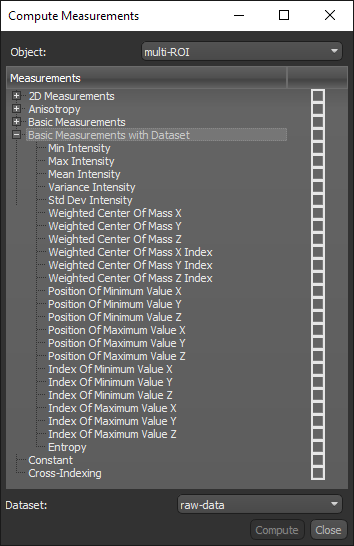
You can compute statistical properties, such as the minimum and maximum intensity values, entropy, weighted centers of mass, and others, that correspond to the selected image data and the discrete objects, or connected components, within a multi-ROI. These measurements are shown in the Compute Measurements dialog, shown below, and are described in the following table.
Basic measurements with dataset

| Measurement | Description | Unit |
|---|---|---|
| Entropy |
Is a histogram-based descriptor that is a measure of information content based on the local histogram shape.
In image processing entropy might be used to classify textures, a certain texture might have a certain entropy as certain patterns repeat themselves in approximately certain ways. A component with low entropy is more homogenous than a component with high entropy. Likewise, a vector with relatively "low" entropy is a vector with relatively low information content. A vector with relatively "high" entropy is a vector with relatively high information content. Note Refer to https://en.wikipedia.org/wiki/Entropy_(information_theory) for more information about entropy. |
none |
| Min Intensity | Indicates the minimum voxel value found for each discrete object in the multi-ROI. | none |
| Max Intensity | Indicates the maximum voxel value found for each discrete object in the multi-ROI. | none |
| Mean Intensity | Indicates the mean value of all voxels found for each discrete object in the multi-ROI. | none |
| Variance Intensity | Indicates the variance of all voxel values found for each discrete object in the multi-ROI. | none |
| Std Dev Intensity | Indicates the standard deviation of all voxel values found for each discrete object in the multi-ROI. | none |
| Weighted Center of Mass X/Y/Z |
Indicates the X, Y or Z coordinate of the weighted center of mass.
Note The center of mass of a distribution of mass in space is the unique point where the weighted relative position of the distributed mass sums to zero. If the object has uniform density, it will be located at the centroid. If not, the weighted position coordinates of the distributed mass defines its coordinates. X-Y locations are described in the world coordinate system. |
default units |
| Weighted Center of Mass X/Y/Z Index | Indicates the X, Y, or Z voxel index of the weighted center of mass. | none |
| Position of Minimum Value X/Y/Z | Indicates the X, Y, or Z coordinate of the minimum value within each object. | default units |
| Position of Maximum Value X/Y/Z | Indicates the X, Y, or Z coordinate of the maximum value within each object. | default units |
| Index of Minimum Value X/Y/Z | Indicates the X, Y, or Z voxel index of the minimum value within each object. | none |
| Index of Maximum Value X/Y/Z | Indicates the X, Y, or Z voxel index of the maximum value within each object. | none |